
End the potholes and the plowing ruts
Gravel to Asphalt Conversion in Oshkosh, WI
Reusing good stone where possible, fixing it where clay has crept in.
- No-charge site visits and written quotes
- Every quote lists base stone depth and compacted mat thickness
- Built for clay ground: drainage planned before paving
From Washboard to Blacktop
A gravel to asphalt conversion turns a stone driveway into a paved one. Around Oshkosh this is common on lake lots along Lake Butte des Morts and Lake Winnebago, on rural properties in the surrounding towns and on older city homes with gravel parking pads or alley drives. Gravel is cheap to install, but it ruts, washes out, gets plowed into the lawn every winter and needs regular regrading. Blacktop ends most of that.
Can the old gravel be the base?
Sometimes. Clean crushed stone that is several inches deep and firm can be regraded, topped up and compacted as the base for the new asphalt, which saves material and hauling. But on clay ground, years of rain and traffic often push clay up into the stone, especially in the tire tracks and low spots. That mixed layer does not drain or support well. We dig test holes at the estimate to see what you have, and we quote reusing, supplementing or replacing the stone accordingly.
Drainage on long drives
A gravel drive lets some water soak through. Blacktop does not, so a long paved drive collects runoff along its whole length. We plan where water will cross or leave the drive: a slight crown so water sheds to both sides, shoulders or ditches to carry it, and sometimes a culvert where the drive crosses a low spot or roadside ditch.
Edges without curbs
Rural and lake-lot drives rarely have curbs, so the asphalt edge is exposed to tires, plows and runoff. We taper the edge, extend the stone base past it and backfill with soil so the edge is supported.
Width, turnarounds and parking
Conversions are a good time to adjust layout: a wider spot near the garage, a turnaround so you are not backing onto a county road, or a pad for a boat or camper. Each added square foot adds cost, so we quote options separately.
Road approaches
Where a rural drive meets a town or county road, the approach and any culvert under it may fall under that road authority's rules. We check before planning approach changes.
Timing a conversion
Gravel drives are easiest to evaluate in late spring, when soft spots and washouts from the thaw are still visible. We pave once the base has dried, usually from late May into fall, so the stone can be compacted properly and the hot mix keeps its heat long enough to roll.
What This Covers
Conversions are mostly base and drainage work.
Test digs
Checking how deep and how clean the existing gravel is.
Regrade and supplement
Reshaping the stone, adding fresh crushed stone and compacting.
Drainage
Crown, shoulders, ditches or culverts so water leaves the drive.
Paving
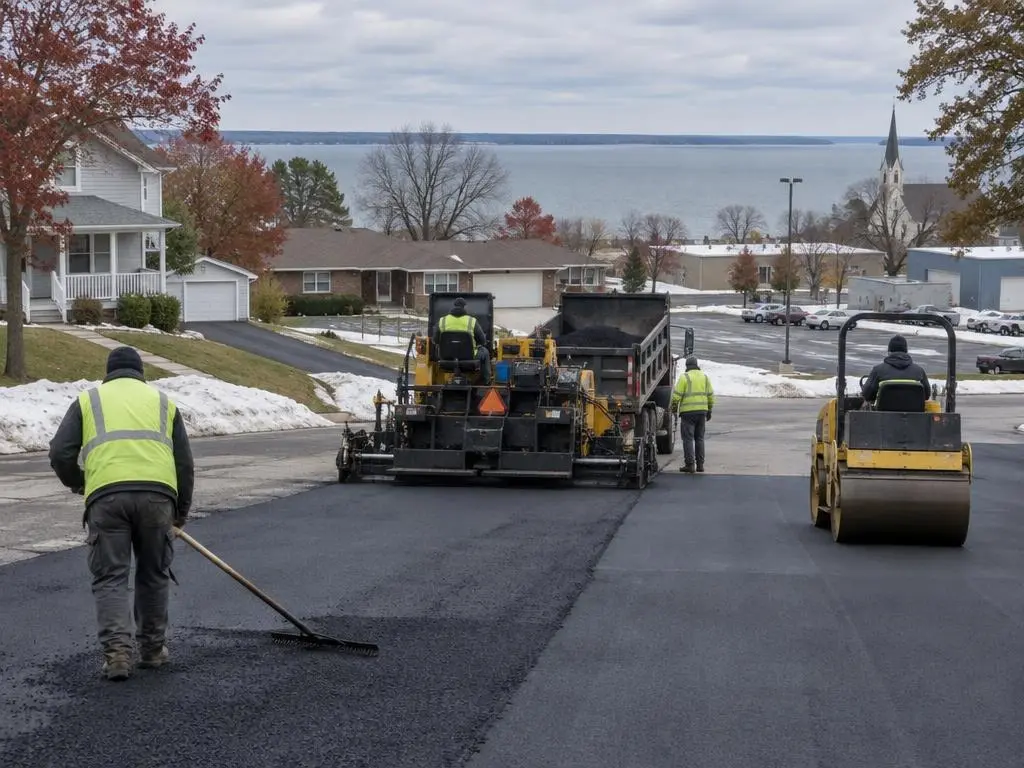
Hot-mix asphalt placed and rolled to the thickness in your quote.
Typical Conversion Costs
| Item | Published range |
|---|---|
| Standard asphalt paving (HomeGuide) | $5 to $12+ per sq ft |
| Recycled asphalt surface (HomeGuide) | $4 to $9 per sq ft |
| Gravel material, for comparison (HomeGuide) | $1 to $3 per sq ft |
| Contractor minimums (HomeGuide) | Some start at $2,000+ |
Reusing sound existing stone can lower the cost; replacing clay-contaminated stone raises it. These are national figures from published cost guides, shown to help you plan. Fox Valley pricing depends on soil, access, size and season. The amount on your written quote is what you pay.
How It Works
1. Test the gravel
We dig a few spots to see depth and condition.
2. Plan drainage
We decide where water will cross or leave the drive.
3. Rebuild base
Stone is regraded, supplemented and compacted.
4. Pave
Asphalt is placed, rolled and edged.
Gravel to Asphalt Conversion Questions
How much cheaper is it to reuse my gravel?
It depends on depth and condition. Clean, deep stone that only needs regrading and topping up can save a noticeable share of base cost. Stone mixed with clay usually has to be removed. We show you the difference in the quote.
Will a paved drive flood my yard?
Not if drainage is planned. Blacktop sheds more water than gravel, so we direct runoff to shoulders, swales or ditches rather than letting it run toward buildings.
Can you pave only part of a long drive?
Yes. Many owners pave the section near the house first and the rest later. We taper and support the transition so gravel does not get pushed under the asphalt edge.
What thickness for a drive that sees trucks or a boat trailer?
Cost guides suggest 3 to 4 inches of asphalt over 8 to 10 inches of base for heavier vehicles. We size it to what will use the drive.
Gravel to Asphalt Conversion Service Areas
- Asphalt Paving in Oshkosh, WI
- Asphalt Paving in Neenah, WI
- Asphalt Paving in Menasha, WI
- Asphalt Paving in Fox Crossing, WI
- Asphalt Paving in Appleton, WI
- Asphalt Paving in Fond du Lac, WI
- Asphalt Paving in Winneconne, WI
- Asphalt Paving in Omro, WI
- Asphalt Paving in Ripon, WI
- Asphalt Paving in Kaukauna, WI
- Asphalt Paving in Little Chute, WI
- Asphalt Paving in Kimberly, WI
- Asphalt Paving in Grand Chute, WI
- Asphalt Paving in Greenville, WI
- Asphalt Paving in Algoma, WI
- Asphalt Paving in Berlin, WI
- Asphalt Paving in Waupun, WI
- Asphalt Paving in Chilton, WI
- Asphalt Paving in New London, WI
- Asphalt Paving in North Fond du Lac, WI
Get a Gravel to Asphalt Conversion Estimate
Free conversion quotes for lake, rural and city lots.